How to Find Your Blogging Niche When “Follow Your Passion” Isn’t Enough
Most advice on choosing a blogging niche starts and ends with “write about what you love.” That’s true as far as it goes, but it skips the part that actually determines whether your blog goes anywhere: whether anyone besides you is searching for it.
A niche that works is the overlap between something you can write about consistently and something people are already looking for. This guide walks through both halves, in the order they actually matter.
Why Passion Alone Isn’t a Strategy
Passion tells you what you’ll still be writing about in year two, after the novelty has worn off. That matters, because a blog built on a topic you find tedious after twenty posts won’t survive long enough to build an audience.
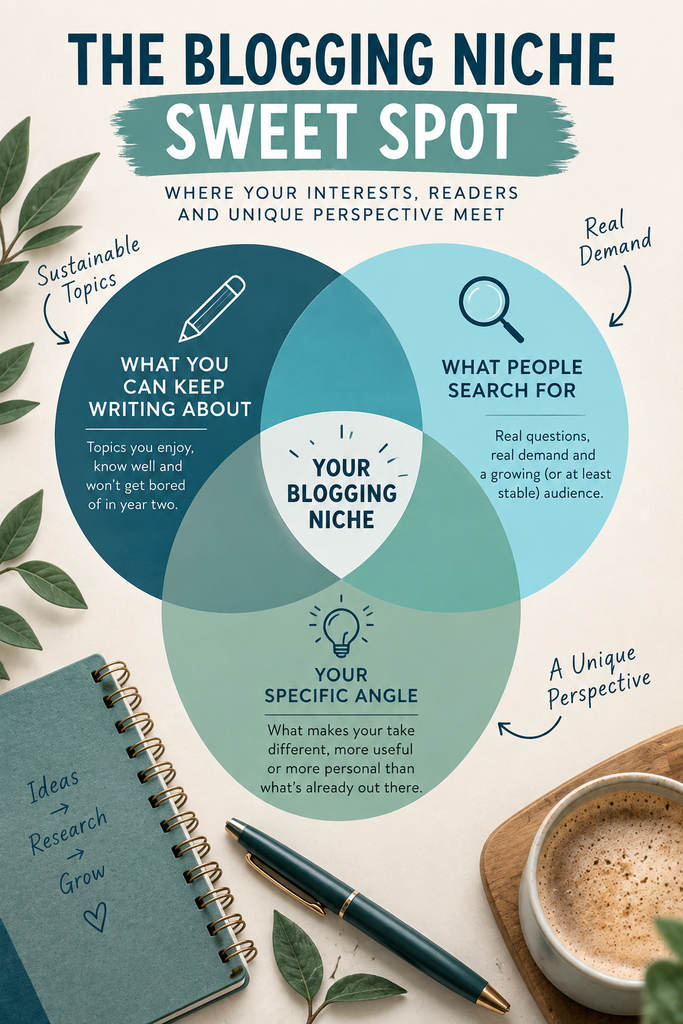
But passion doesn’t tell you whether that audience exists. Plenty of genuine interests are too narrow, too personal, or too well covered already to support a blog on their own. The self-reflection exercises worth doing here are simple: notice what you keep talking about unprompted, what you research for fun rather than for work, and what friends or colleagues already ask you for advice on. Those are stronger signals than a list of hobbies, because they point at things you have something to say about, not just things you enjoy.
Turning an Interest into a Content Angle
The gap between “I like cooking” and “I have a blog about cooking” is the angle. Minimalist Baker built its audience around simple, ingredient-light recipes rather than cooking in general. Smart Passive Income built its audience around teaching online business mechanics, not entrepreneurship as a broad topic.
The pattern in both cases is specificity. A general interest becomes a workable niche once you can describe, in one sentence, who it’s for and what makes your take on it different from the next general food or business blog.
Checking Whether Anyone Is Actually Searching For It
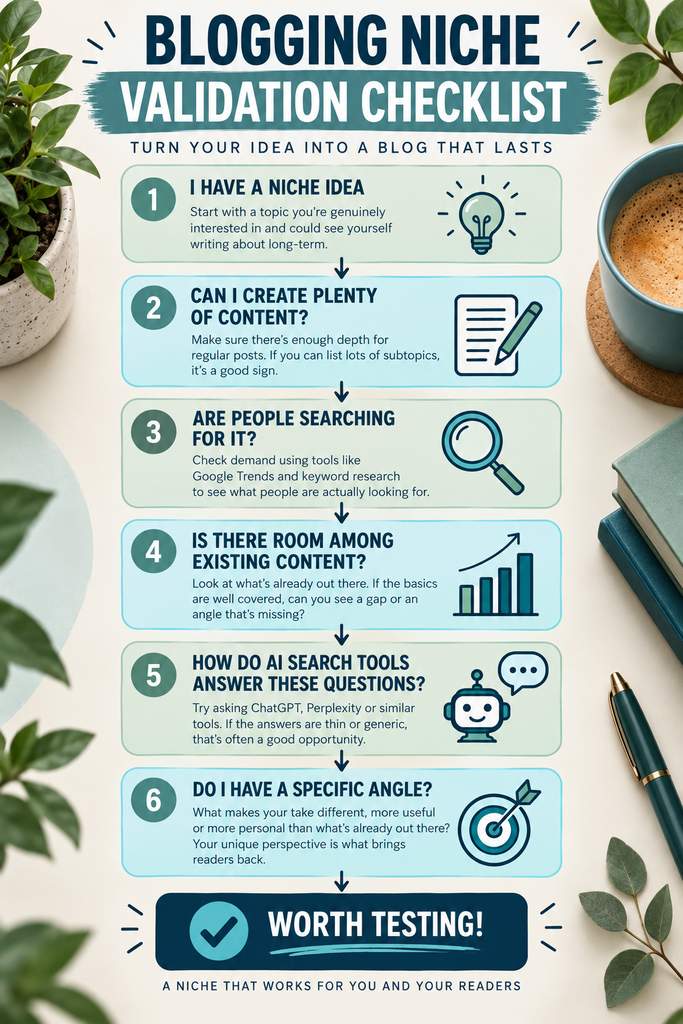
Once you have a candidate niche, the next step is finding out whether it has demand, and demand is easier to check than most new bloggers assume. Google Trends will show you whether interest in a topic is flat, growing, or declining over time, which matters more than a single snapshot of search volume. A keyword research tool will show you what people actually type when they’re looking for content like yours, which is often more specific and more commercially minded than the topic you started with.
Competitor research does a different job: it tells you what’s already been covered well, and where the gaps are. If every existing blog in a space covers the basics but skips the awkward, practical questions, that gap is often more valuable than the traffic those basics still bring in.
If the research turns up a topic that’s technically popular but has almost no room left in it, don’t discard the interest, just widen it. A blog built narrowly around rare stamp collecting has a real ceiling; the same interest reframed around collectibles or social history doesn’t.
Checking How AI Search Tools Already Answer Your Niche’s Questions
Search behaviour has shifted since niche selection was purely a Google exercise. A growing share of research now happens through tools like ChatGPT and Perplexity, and it’s worth using them the way you’d use a competitor audit. Ask them the core questions your intended niche would need to answer, and see what comes back.
A confident, well-sourced answer already sitting there is the same signal a page-one competitor would be: the easy ground is taken. A thin, generic, or poorly cited answer is the opposite signal, and often a better opportunity than a Google-only search would reveal, because it shows where even AI-generated summaries have nothing solid to draw from yet. This isn’t a replacement for keyword or competitor research, just an additional check worth running before you commit.
Choosing a Niche That Can Actually Support a Blog
A niche that survives long-term needs enough depth to generate posts without repeating yourself for months. If you can list every subtopic within an afternoon, the niche is probably too narrow to sustain regular publishing. Content pillars solve this in practice: instead of picking one theme, pick three or four adjacent themes under a shared umbrella, so you always have somewhere to go next when the obvious posts run out.
Your domain name should reflect the niche without boxing you into it too tightly. A name built entirely around one sub-topic can become a liability if the blog evolves, which is common in the first year or two as you learn what actually gets read.
What Makes a Niche Yours
Search demand gets people to a blog post. It’s the specific angle that gets them to come back. That might be direct personal experience, a particular framework you keep returning to, or simply a willingness to say something more useful than the standard advice.
This is also where reader trust starts to build. A blog that consistently answers the question a reader actually had, rather than a vaguer version of it, earns return visits in a way that generic coverage of the same topic doesn’t.
Launching Without Overbuilding First
New bloggers often delay launching until everything feels finished, which usually costs more momentum than it’s worth. A handful of solid posts ready before launch day is enough. What matters more than volume at this stage is having an email list started early, even a small one, since it gives you a direct line to readers that doesn’t depend on search rankings or social algorithms.
Guest posting on established blogs in your niche is still one of the more reliable ways to reach an audience that doesn’t know you exist yet, provided the post genuinely fits the host blog rather than reading as a thinly disguised pitch for your own site.
Growing a Blog Once It’s Live
Growth after launch comes down to two things that are easy to state and harder to sustain: publishing consistently, and actually engaging with the people who show up. Responding to comments, taking reader questions seriously enough to turn them into future posts, and showing up where your audience already spends time all compound over months, not days.
None of this replaces having a workable niche in the first place. It just determines whether that niche turns into an audience or stays a hobby with a domain name attached.
A blogging niche that works is never the topic you’re most passionate about in isolation. It’s the topic you’re genuinely willing to keep writing about, that also has enough real search demand to be worth the effort, and that’s specific enough for you to say something the next ten blogs in the space haven’t already said.