

How Often Should You Publish Blog Posts? A Framework Beyond “It Depends”
Ask ten bloggers how often you should publish and you’ll get ten different answers, most of them starting with “it depends.” That answer is technically correct, and also useless on its own. What actually depends on what, and how do you turn that into a schedule you can stick to?
This isn’t a post about picking a number out of the air and hoping it works. It’s a way to work out your own answer using your niche, your content type, and your own analytics data, rather than someone else’s guess.
Why “It Depends” Isn’t a Cop-Out
The phrase gets a bad reputation because it’s often used as a dodge. But posting frequency genuinely is shaped by a handful of concrete variables, and once you name them, the advice stops being vague.
The main ones are content type, niche velocity, and production capacity. A news or trend-driven blog needs to publish faster than an evergreen how-to site, because the value of a news post decays within days. A solopreneur writing one deeply researched guide a week isn’t behind a competitor pushing out five thin posts in the same period; they’re playing a different game entirely.
Some of this gets decided before you ever set a posting schedule, since the platform underneath your blog shapes what’s realistic to publish and how often. If that groundwork isn’t settled yet, it’s worth reading What Features Actually Matter When Choosing a Blogging Platform before locking in a frequency you might have to walk back.
Production capacity matters just as much as strategy. A schedule that assumes eight hours a week of writing time when you actually have three isn’t a content plan, it’s a to-do list you’ll abandon by week four.
Match Frequency to What Your Blog Is Actually For
Before setting a number, it helps to know which of these categories your blog falls into, since each has a different relationship with frequency.
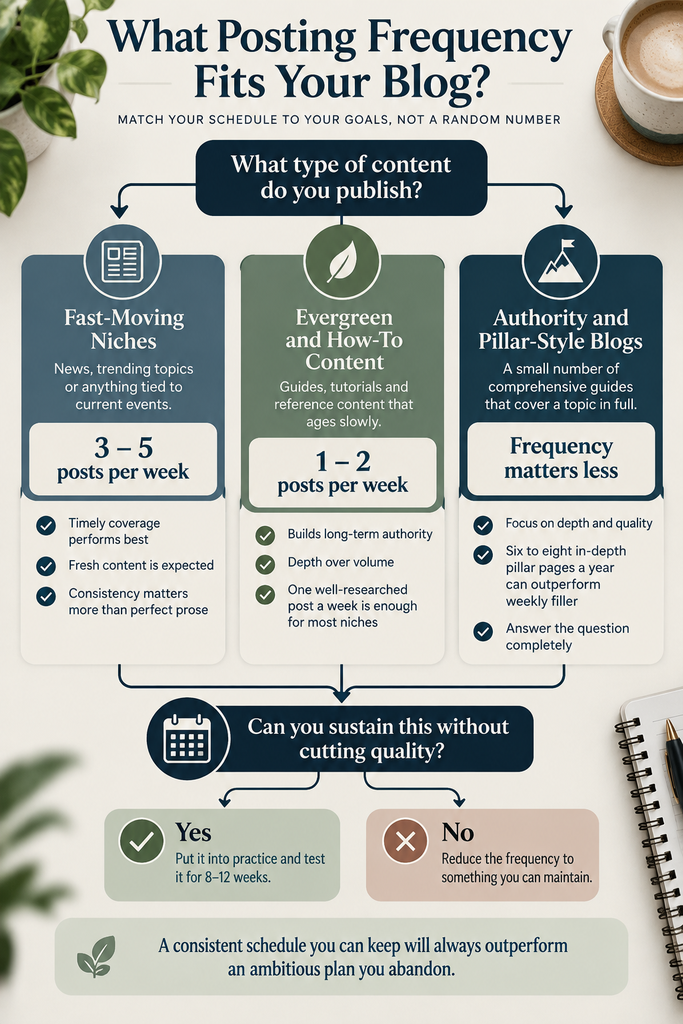
Fast-Moving Niches
Technology news, trending topics, and anything tied to current events reward speed. Search engines and readers both expect fresh coverage, and a well-optimised roundup published the same week a story breaks will usually outperform a more polished piece published a month later. If this is your niche, three to five posts a week is a realistic target, and consistency matters more than perfect prose on any single post.
Evergreen and How-To Content
Guides, tutorials, and reference content age slowly, so the pressure to publish constantly is lower. One well-researched, thorough post a week is enough to build authority in most evergreen niches, and two is plenty for anyone working solo. The goal here is depth that keeps ranking for months or years, not volume that gets buried the day after it’s published.
Authority and Pillar-Style Blogs
If you’re building a small number of comprehensive guides that each cover a topic in full rather than dozens of shorter posts, frequency stops being the main metric altogether. A blog built around six or eight genuinely exhaustive pillar pages a year can outperform one publishing weekly filler, because search engines and readers both reward the post that actually answers the question completely.
The Real Constraint Is Time, Not a Content Calendar Ideal
Most posting-frequency advice assumes unlimited hours. For a solopreneur, the honest starting point is the opposite question: how many hours a week can you realistically give to writing, editing, and promoting a post, without that time coming out of the work that pays the bills?
Work backwards from there. If a well-researched 1,500-word post takes you four hours from outline to publish, and you have six hours a week for blogging, you’re looking at once a week with some buffer, not twice. Committing to more than your capacity supports is how blogs go quiet for three months, which does more damage to search rankings than a slower, sustained schedule ever would.
A visible calendar makes that capacity easier to respect instead of overriding it on a whim. How to Use Trello for Blogging: Build an Editorial Calendar You’ll Actually Stick To walks through setting one up specifically for a solo content schedule.
Quality is the other side of this constraint. A rushed post that skips research or reads like it was written to hit a deadline rather than answer a question will underperform a slower, better one. If you’re choosing between publishing twice a week at a lower standard or once a week at a higher one, the once-a-week version wins for search performance and reader trust almost every time.
A Testing Framework That Actually Works
Guessing at a frequency and sticking with it regardless of results is the mistake worth avoiding. Instead, treat your first attempt as a test with a defined end date and clear metrics, not a permanent decision.
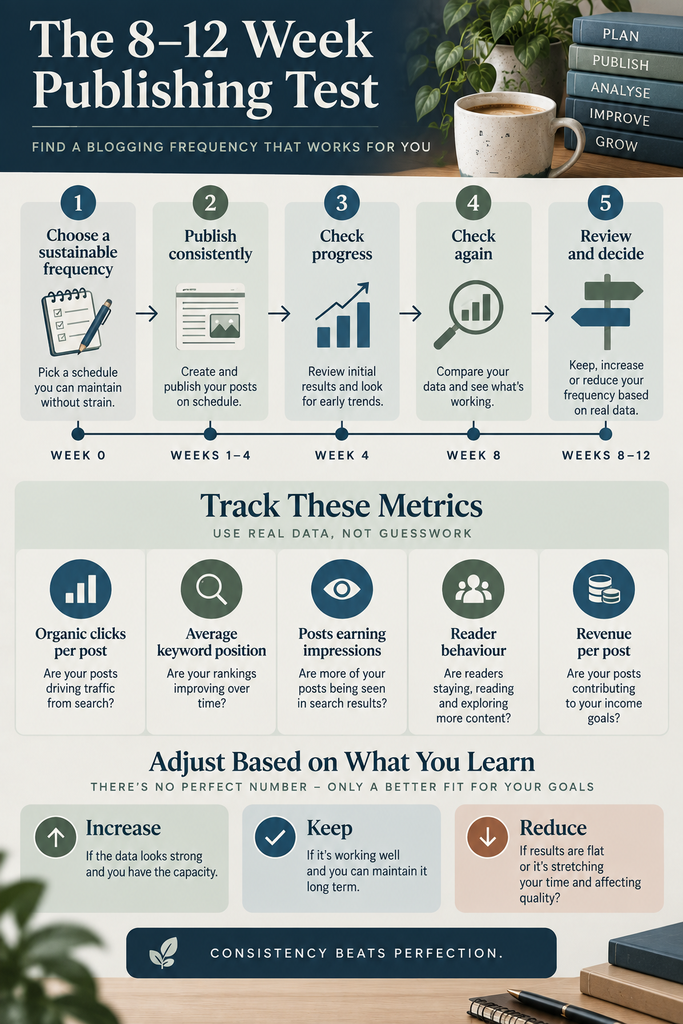
Pick a frequency you can sustain for eight to twelve weeks without strain, since that’s roughly the minimum window for search engines to properly index and rank new content and for any real pattern to show up in your data. Publishing for two weeks and judging the results tells you almost nothing; search visibility for a new post commonly takes a month or more to stabilise.
During that window, track three things in Google Search Console and Analytics: organic clicks per post, average position for your target keyword at the four-week and eight-week marks, and how many of your posts from that period are earning any impressions at all. If most of your posts are getting meaningful traffic by week eight, your frequency and quality bar are working together well. If most are sitting at zero impressions, the problem usually isn’t frequency, it’s keyword targeting or content depth, and publishing faster won’t fix either.
Keeping that data next to your publishing log rather than in a separate spreadsheet makes the pattern easier to spot. Using Airtable for Blogging: The Only Guide You Need to Organise Your Content Business covers a setup built for exactly this kind of tracking.
What to Watch Beyond Raw Traffic
Traffic is the easiest number to check, but it isn’t the only one worth watching. Average time on page and scroll depth tell you whether people are actually reading what you wrote or bouncing off the introduction, which is a much more honest quality signal than pageviews alone.
Newsletter sign-ups and return visits are worth tracking separately from search traffic, since they measure whether your existing audience finds each new post worth coming back for. A blog that’s slowly building a loyal reader base on a lower posting frequency is in a stronger long-term position than one chasing search traffic from readers who never return.
If you’re monetising through affiliate links, ads, or your own products, revenue per post over that same eight-to-twelve-week window is the metric that actually matters to the business, and it doesn’t always correlate with traffic volume the way you’d expect. A single well-targeted post that converts can outearn five posts that only bring in browsers.
When to Slow Down
There’s a point where more frequent publishing actively works against you, and it’s worth recognising the signs before burnout forces the decision. If your last few posts have taken noticeably longer to research and write than your earlier ones, or you’ve started skipping the editing pass to hit a self-imposed deadline, that’s a signal to scale back rather than push through.
A thin, rushed post published on schedule does less for your blog than a stronger post published a few days late. Search engines don’t reward punctuality, and readers remember quality far more than they notice a missed Tuesday.
If the strain is coming from juggling the blog alongside everything else the business needs, the fix is often organisational rather than a lower word count. ClickUp for Bloggers: How to Organise Your Whole Content Business, Not Just the Blog is worth a look before cutting frequency further.
Finding Your Number
There isn’t a universal answer to how often you should publish, but there is a reliable way to find your own: match your frequency to your content type and niche, set it at a level your actual schedule can sustain without quality slipping, and test it for eight to twelve weeks against clicks, rankings, and reader return behaviour before you commit to it long term. The right frequency for a solopreneur blog is the fastest pace you can sustain without the writing getting worse, verified against your own Search Console data rather than borrowed from someone else’s schedule.


